Key takeaways
- CCPA study on 85 farms: feed efficiency increases with starch, up to 6 to 8 kg per cow per day.
- In 2026, maize silage provides approximately 1.5 kg less starch per cow per day.
- Straw cereals, more economical than grain maize, degrade faster in the rumen.
- Amiviv, a phytogenic solution, helps slow down starch degradation in the rumen.
Starch and feed efficiency: what 85 farms show
CCPA recently studied 85 dairy farms. Result: the feed efficiency of ruminants increases with the amount of starch in the ration. It plateaus from 6 to 8 kg of total starch per cow per day.
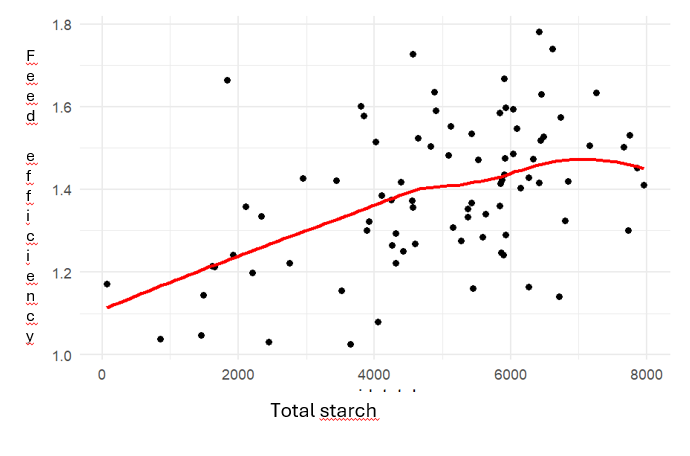
Feed efficiency is also positively correlated with the margin over feed costs. An additional 0.1 point of feed efficiency represents approximately €0.70 of additional margin per cow per day. A ration lacking starch therefore directly impacts the farm’s margin.
Starch degradability: what balance between rumen and intestine?
But beware, not all starches degrade and are assimilated in the same way. A balance must be maintained between the part degraded in the rumen and that digested in the intestine. Without this balance, the risk of subacidosis (subacute acidosis) increases and efficiency declines.
Starch from straw cereals (wheat, barley, triticale) is a source of energy that is rapidly fermented in the rumen. It feeds the ruminal flora but also produces acids in a short time. If the intake is too high, the rumen pH drops.
Starch from grain maize degrades more slowly. A portion escapes the rumen and is digested in the intestine: this is known as “by-pass” or intestinal starch. It provides energy without acidifying the rumen.
Concentrating a ration in starch therefore consists of combining these two sources. The rumen’s capacity to absorb rapid fermentation must be respected.
Maize silage in 2026: 1.5 kg less starch to compensate for each day
This year, maize silages show starch levels that are lower by about 10 points. For 15 kg of ingested silage dry matter, this represents 1,500 g less starch provided by the forages. This will need to be compensated for!
Grain maize or straw cereals: which starch source to choose?
Furthermore, the cereal market is disrupted. Price increases are marked for raw materials of interest rich in intestinal starch, such as grain maize.
It therefore seems more economical to turn towards straw cereals or certain co-products. However, their starch is more heavily degraded in the rumen. The economic gain must then be accompanied by good management of ruminal fermentation.
Amiviv: slowing down the degradation of straw cereal starch in the rumen
Amiviv is a phytogenic solution. It orients the ruminal flora in order to reduce the speed of starch degradation in the rumen. Station tests have characterised its impact on various raw materials and at the ration scale.
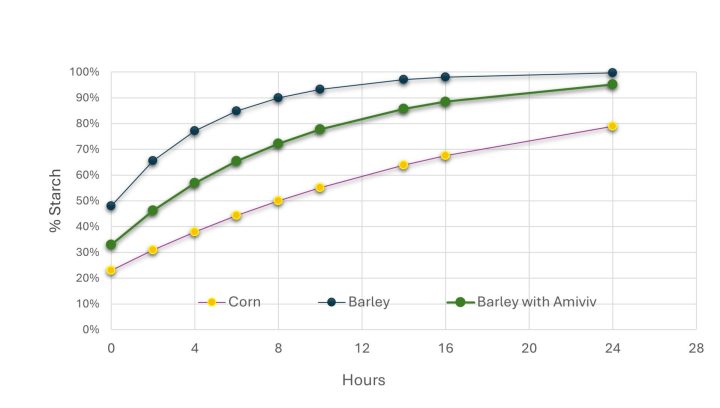
With Amiviv, it becomes possible to replace the starch lost by this year’s maize silages. Complementary feeds rich in starch can then incorporate straw cereals or co-products, while controlling starch degradation in the rumen. It is also an economic alternative to the lack of availability of grain maize this year.
To support you in this prospect, the Chorus cattle rationing software offers specific recommendations. These concern the kinetics of starch degradation.
Situations at risk of acidosis in dairy cows: the contribution of Acidoline
When exposure to a ration rich in rapidly fermentable starch is prolonged and signs of acidosis appear, slowing down starch degradation is no longer enough. Faced with a drop in intake, butterfat content (TB), or milk production, it becomes necessary to quickly support ruminal and metabolic balance.
Acidoline combines buffering substances, yeasts, and carboxylic acid salts with complementary actions. The buffering substances help limit pH variations and the yeasts feed the ruminal flora. The carboxylic acid salts, for their part, stimulate lactate-consuming bacteria, which reduces the amount of lactic acid in favour of propionic acid.
Acidoline thus helps reduce the risk of ruminal and metabolic acidosis and preserve animal performance. In case of doubt regarding the health status of the herd, the advice of your veterinarian remains essential.
Building a ration adapted to each farm
Every ration is different. The correct starch concentration depends on the forage, the production level, and the available raw materials.
CCPA teams support feed manufacturers, technicians, and farmers. They help analyse silages and build, using the Chorus software, a ration adapted to each herd.
Discover our solutions for ruminant nutrition and contact your CCPA representatives.