Home » News » 2025 Food Trends: What are the impacts on consumption and livestock farming?
Publish on : 27 February 2025
2025 Food Trends: What are the impacts on consumption and livestock farming?
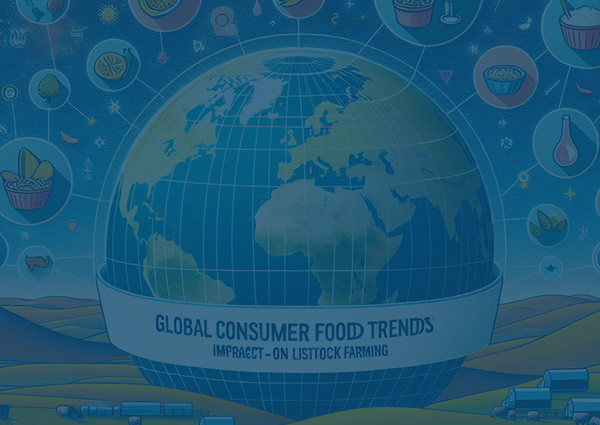
Every year, the CCPA Group conducts an analysis of global food trends, which inform and inspire our future innovations across the entire animal production sector. This analysis is based on three sources of data: newly launched innovations, the most popular food products from the previous year, and the expectations of global consumers.
Throughout 2025, the positions of major trends remain stable, with little change in the hierarchy compared to 2024. Indeed, there has been a slowdown in innovations launched in 2023 and 2024, as inflation hindered R&D projects and retailers simultaneously rationalized their shelf offerings, leaving less room for innovation.
Sustainable Food: Consumers are choosing more ethical foods with a lower environmental impact. This trend remains the primary driver of agri-food innovation.
Health Food: Slight progression in health foods launched in 2024, with a tendency to pay more for healthier products.
Smart Shopping: A return to home-made meals and the growth of private labels; the recovery of food consumption remains sluggish in Europe.
Naturalness and Plant-based: Progression of plant-based meals with numerous innovations in alternatives to animal proteins; the share of declared flexitarians is nearly 1/2 worldwide.
Personalization: Increase in pleasure and comfort foods in response to an anxiety-inducing context. Success also for fusion food that blends recipes from different countries (ramen burger, sushi burritos, etc.).
Transparency: Labels and information on packaging are flourishing, though there is a delay in the launch of an environmental label in Europe and France.
Omnichannel Food: Slight decline in this trend. Notably, social media is becoming a major channel for product promotion via food influencers.
These food trends influence production chains and animal nutrition.
2025 Food Trends: What are the impacts on animal nutrition and production?
Sustainable Food Trend
The reduction of the environmental footprint is a major priority in animal nutrition. Several examples can be cited.
Notably, there is a commitment from the industry and inter-professional bodies to reduce the use of deforestation-linked soy in livestock feed. At the European level, the implementation of the EUDR regulation has been delayed, but “Protein Plans” are in place to reduce local dependence on imported products in France, Germany, Denmark, Belgium, and the Netherlands.
The harmonization of “green” labeling for livestock feed at the European level based on PEFCR and GFLI standards is also underway. The application of the CSRD regulation, which requires non-financial reporting on Environmental, Social, and Governance (ESG) issues and actions for companies with more than 250 employees starting in 2026, will affect many clients and partners, including CCPA.
Additives reducing methane emissions are also being deployed in Europe, America, Oceania, and Asia, driven by demand from downstream players (dairies, retailers). Following experimental phases, these products are now being deployed in the field.
Finally, beyond environmental footprint reduction, biodiversity is emerging as a subject of interest, particularly for the ruminant sector and extensive farming, through the maintenance of meadows and the improvement of protein autonomy.
Health Trend
There are multiple global research projects and advances in the field of quorum sensing (cellular communication between bacteria) and its applications in animal nutrition. Demedication also remains a major focus across all regions. This is notably one of the key themes of the VIV ASIA 2025 trade show.
Smart Shopping Trend
Inflation has had negative effects, leading to a continuous decline in the consumption of meat and charcuterie products. Combined with the erosion of the number of farmers in the EU and cattle herds, this has weakened the slaughterhouse link as well as animal nutrition stakeholders. Also of note is the 2024 signing of the MERCOSUR agreement, which causes several EU member states to fear the arrival of cheaper imported animal products on the community market. Furthermore, at the start of 2025, the anti-dumping measure applied by the EU could represent an additional cost of €4 to €5/t of feed for pigs and poultry, considering that lysine is especially crucial for monogastrics. This prospect raises fears of an increase in production costs on farms and potentially for meat products.
Among the positive signals of this Smart Shopping trend, we can cite the strong momentum of poultry products (eggs and meat), favored by consumers for their good value for money. In 10 years, French consumption of eggs and egg products per capita has increased by 35 eggs, or +3.5 eggs/year. France became the leading egg producer in the EU again in 2023.
Finally, nutritional expertise regarding the improvement of feed efficiency has never been as extensively worked on as last year by all animal nutrition stakeholders, as a path toward economic optimization progress in farming.
Within the CCPA Group, these major trends resonate with numerous research and innovation projects and field solutions in terms of sustainability and feed efficiency. Do not hesitate to contact us to discover them!
With nearly 10 percentage points less starch compared to 2025, initial 2026 corn silage analyses reveal a marked shift in the nutritional profile of forages....
Do you have a question? Need to speak with one of our advisors?